


Updated as at 26 June 2026 · Now passed both houses (25 June 2026) — we will update this article as the remaining detail is released.
Last month’s Federal Budget delivered the most significant change to capital gains tax in a generation and, as of 25 June 2026, it has passed both houses of Parliament. In this piece, we want to dig beneath the headlines and the many lines of complaint written about these changes, and turn our attention to a ‘what can I do about it’ and ‘how do I best deal with this’ lens.
In brief
Capital gains tax applies, unsurprisingly, to your ‘gain’ — broadly, your sale proceeds less your cost base— and both the current and new rules reduce the gain that is taxed, but via different mechanisms.
Today, the relief sits on the gain itself: assets held more than 12 months attract a flat 50% discount, so half the gain is taxed at your marginal rate, and the other half is effectively tax-free. From 1 July 2027, the new law removes the discount and moves the relief to the cost base — indexing it by CPI over your holding period, so only the real gain (the part above inflation) is taxed, at your marginal rate or a 30% minimum, whichever is higher. The two are not equivalent: for the concentrated, low-cost-base holdings most founders have, indexation results in materially more tax, which is, of course, the intent of the change.
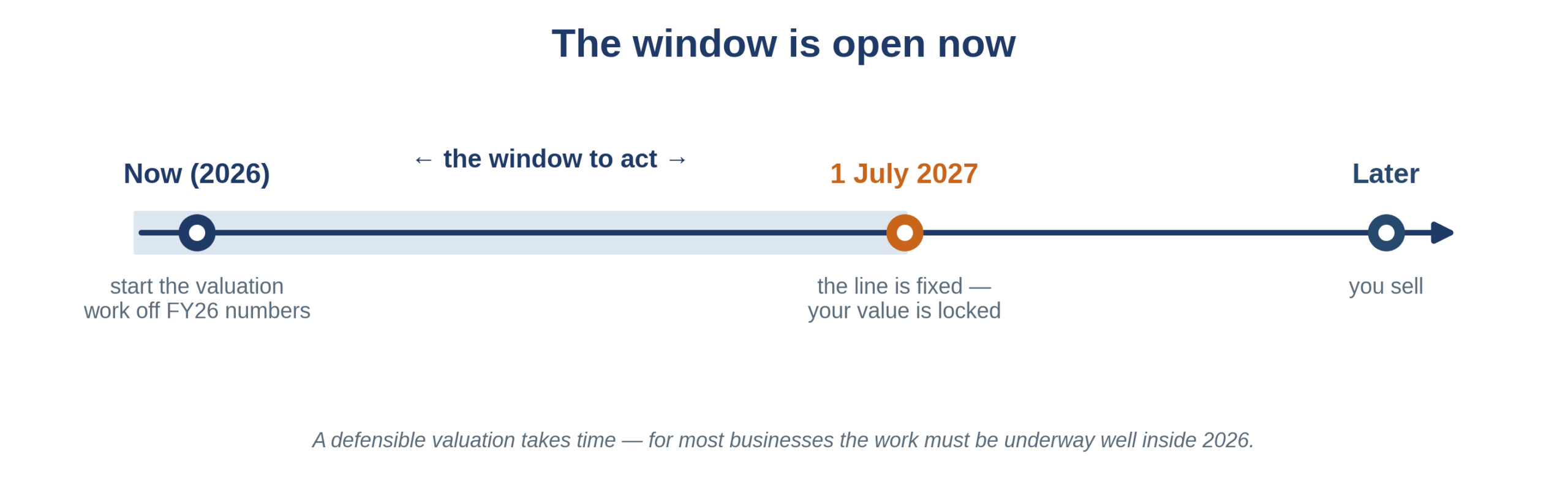
For founders who already own a business, the transition contains one important feature: the gain is split at that date, and the portion accrued before 1 July 2027 retains the current discount. The dividing line is your business’s value at 1 July 2027 — and the most defensible way to fix it is a valuation established now and updated to that date, not one struck cold at the line or reconstructed afterwards. A figure that was already on foot and simply refreshed is far harder to dismiss as engineered for the result.
For most founders above the small-business concession thresholds, that means the work needs to be underway well inside 2026. One caveat to flag up front: the final package now includes a carve-out for qualifying ‘innovative businesses’ (covered below) that may preserve the 50% discount, and lifts the small business active-asset reduction threshold to $10m turnover — so confirming whether you qualify is now the first step.
First, check whether this applies to you
Two gates can take you out of all of this.
If your sale is fully covered by the small-business CGT concessions, or you qualify for the new innovative-business carve-out, you may keep the existing treatment — in which case the pre-2027 valuation question may not arise. Both are now part of the legislated package and covered in detail below, but they are worth checking first, because for some founders, they change everything.
The carve-out in particular is wide (companies under 10 years old, turnover under $50m). The same package also lifted the small business active-asset reduction threshold to $10m turnover, so more businesses are now caught by the concessions than before.
What are the changes?
From 1 July 2027, three changes work together.
1. Cost base and indexation
Your cost base is broadly what the asset cost you — the price you paid plus certain acquisition and improvement costs. Your capital gain is the sale proceeds less the cost base.
Under the new law, the cost base is lifted in line with inflation (CPI) over the period you have held the asset, so only the real gain — the part above inflation — is taxed.
2. The 50% discount is abolished — for most.
The 50% CGT discount has applied since 1999, halving the taxable gain on assets held more than 12 months. From 1 July 2027 it is removed for individuals, trusts and partnerships. Companies, foreign and temporary residents, and complying super funds (including SMSFs) keep their existing treatment — as do certain new-housing investors and qualifying ‘innovative businesses’ (covered below), both preserved in the final legislation.
That super funds are spared is not a workaround for an operating business: a complying fund is bound by the sole-purpose test and cannot generally carry on an active business or acquire assets from its members, so a trading company cannot simply be moved inside super to access the fund rate. For most holdings, indexation is highly likely to provide significantly less relief than the flat 50% discount.
3. The 30% minimum tax
The new law also sets a minimum effective tax rate of 30% on capital gains. Its stated purpose is to stop gains being deferred into low-income years — for example, retirement — so they are taxed at a low marginal rate.
Where the rate that would otherwise apply to your gain falls below 30%, the floor is set at 30%. As enacted, this minimum applies to resident individuals — including an individual who receives a gain as a trust beneficiary — and not directly to trustees, companies or super funds. A separate regime for the taxation of discretionary trusts has been flagged but not yet released. For founders already taxed at the top marginal rate, the floor is unlikely to be the binding constraint; for them, the shift from the 50% discount to indexation is the more relevant change.
Two carve-outs: income-support recipients (including age pensioners) are exempt from the 30% minimum rate; and investors in new housing may choose between the existing 50% discount and the new treatment when they sell.
Where the law now stands
The enabling bill — the Treasury Laws Amendment (Tax Reform No.1) Bill 2026 — passed both houses of Parliament on 25 June 2026, after the Government struck a deal with the Greens to secure the Senate. The Coalition opposed it. The measures apply to capital gains accruing from 1 July 2027. Royal Assent is now a formality; the substantive law is settled.
The final form reflects the Greens’ price for support. Among the amendments: the Treasurer’s discretion to extend the 50% discount to new asset classes was removed (so a future Minister cannot quietly restore it), and a ban on future SMSF borrowing to buy residential property was added. To address start-up and small-business concerns, the Government also lifted the small business active-asset reduction turnover threshold from $2m to $10m and added the innovative-business concession.
The pre-2027 protection this article describes survived in the final law: gains accruing up to 1 July 2027 keep the 50% discount, with the dividing line set by the value at that date. That is now a feature of the legislation, not a proposal — which makes acting on it a question of execution, not of waiting to see whether it survives.
One thing is still outstanding: the detailed transitional mechanics — the apportionment method and the supporting valuation calculators and guidance — are to be set in delegated legislation that has not yet been released. Helpfully, you do not have to choose between a market valuation and the apportionment method until you lodge for the year you actually sell. But the market-value evidence has to be contemporaneous to 1 July 2027, which is exactly why the work cannot wait for the instrument.
How your gain is divided at 1 July 2027
For an asset you own now and sell after 1 July 2027, the new law splits your gain into two components. The portion that accrued up to 1 July 2027 retains the 50% discount. The portion that accrues after that date falls under the new regime. The dividing line is the value of your business at 1 July 2027.
Technically, the law does this by treating the asset as sold and immediately reacquired just before 1 July 2027. The pre-2027 gain is not taxed then — it is deferred until you actually sell, and at that point is taxed under the old rules, with the 50% discount if it applies.
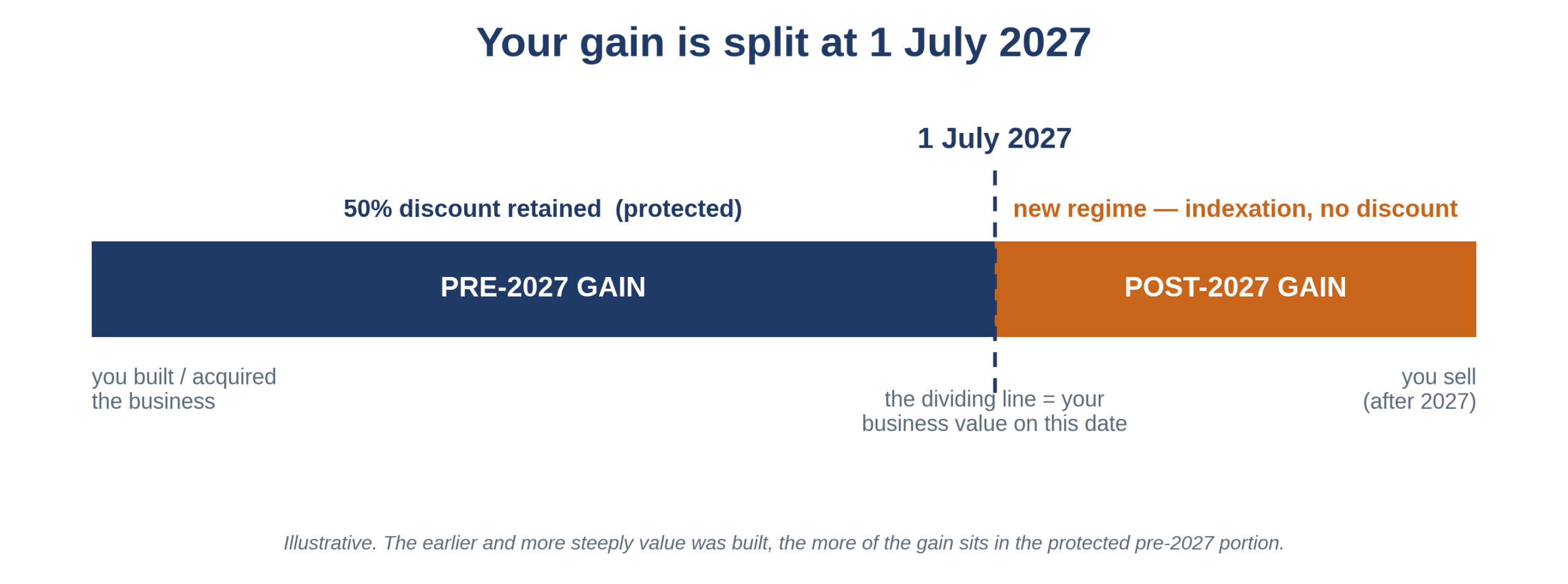
For an owner with a relatively low cost base (most founders, as you have built rather than bought), a meaningful share of your eventual gain may sit on the pre-2027 side of that line. That is the feature worth understanding. But it is not automatic. How the line is drawn is a decision.
Formal valuation vs the apportionment formula: which is better?
Under the new law, the relevant value at 1 July 2027 can be established in two ways:
– A formal valuation of the business as at 1 July 2027; or
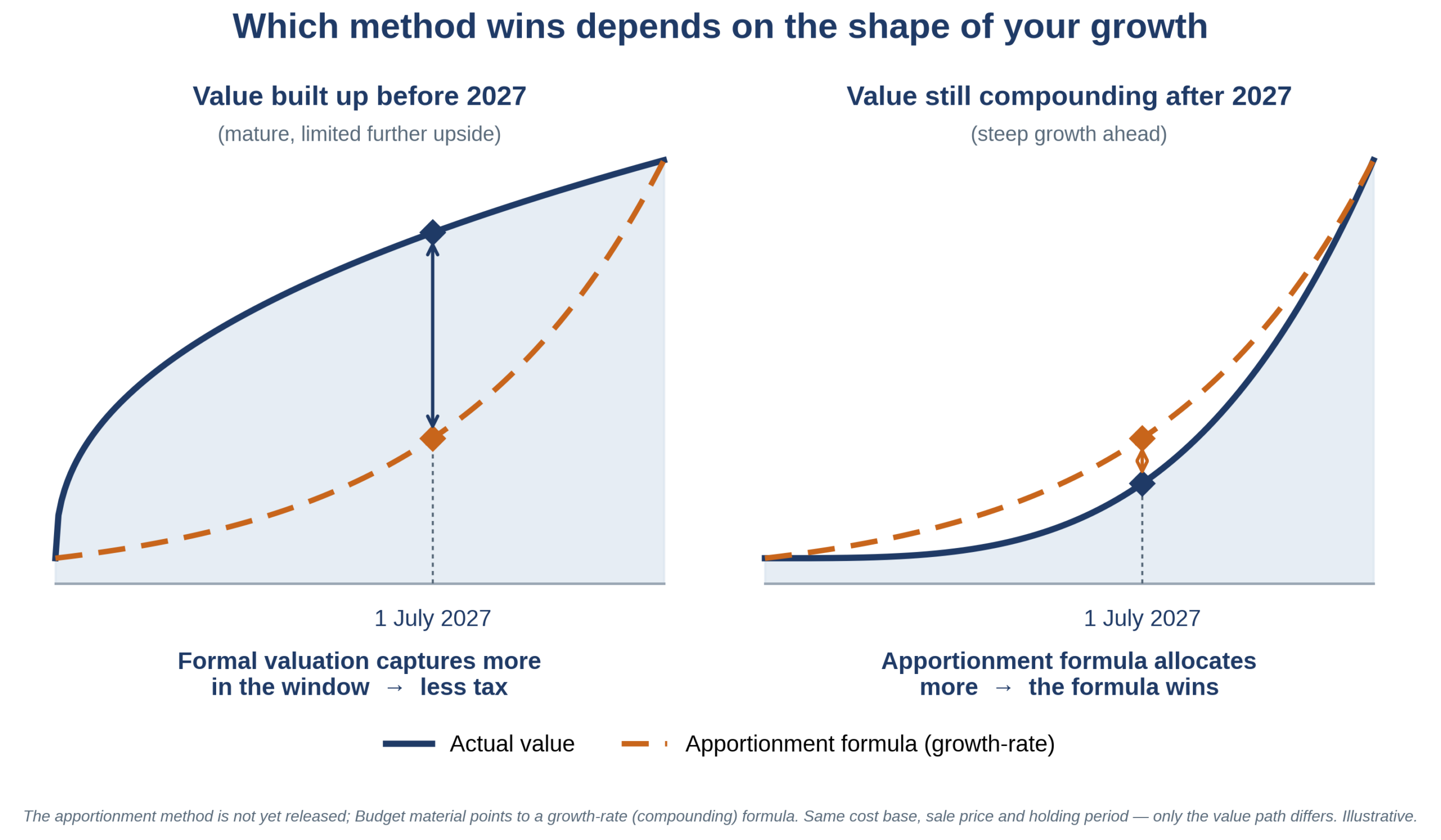
– A prescribed apportionment formula. This method has not yet been released — it will be set by a Ministerial legislative instrument — but the Budget explanatory material points to a growth-rate (compounding) formula: it back-solves the 1 July 2027 value assuming the asset grew at a constant rate across your whole ownership period, which tends to allocate less value to 2027 than a simple split by time would.
These methods will typically not produce the same number, and which one favours you depends on your historic and likely future growth profile. A business whose value appreciation is concentrated pre-2027 — mature, recently scaled, with relatively limited further upside — tends to be under-valued at 2027 by the formula, so a formal valuation captures a greater proportion of the value within the protected window. A business still in a steep growth phase that will keep compounding well after 2027 is likely to be better served by the formula.
Because the formula is not yet released, treat this as the likely shape rather than a settled rule — but the point holds: know which side of that line you fall on before you have to choose.
An illustration
Take a founder with a $200,000 cost base, a business independently valued at $6m on 1 July 2027, and sold for $7.5m in 2031.
Note: Figures are illustrative, assume the top marginal rate, and depend on rules not yet finalised.
– The gain to 1 July 2027 — roughly $5.8m — retains the 50% discount.
– The gain after 1 July 2027 — roughly $1.5m — falls under the new regime, with indexation reducing the taxable portion.
The decision-relevant question is where the line sits. Each additional $1m of value established in the protected window — rather than left to fall under the new regime — is worth, very roughly, $165,000 to $235,000 in tax, depending on how long after 2027 the sale occurs and inflation over that period. The benefit is largest for a sale soon after 2027 and shrinks the longer the post-2027 period runs. For a business of any scale, the difference between the two methods can be material.
Before and after, in plain terms. Picture the same founder, the same $7.3m gain, sold the same year— once under today’s rules and once under the new law.
Selling later shifts more of the gain onto the ‘after’ side, so more is taxed under the new regime. Your lever: a defensible 1 July 2027 value moves gain onto the protected ‘before’ side.
The practical takeaway: establishing a strong, defensible value at 1 July 2027 is what moves gain onto the protected “before” side of the line — and that is the lever you control.
Which founders benefit most from a formal valuation?
If your sale would be fully covered by the small-business CGT concessions — or you qualify for the new innovative-business carve-out (see below) — none of this applies. The rest of this is for businesses outside those, where the choices below carry real consequences. There is an important interaction with the carve-out, which is limited to companies under 10 years old: the founders for whom a valuation matters most tend to be the ones the carve-out does not reach, and vice versa.
Selling the assets, or selling the shares?
There is a second decision that sits alongside the valuation question, and it can matter just as much to what you keep. If your business is held in a company, a sale can be structured two ways — and the tax outcome is very different.
Selling the shares. You (and any fellow shareholders) sell your shares in the company. The gain is taxed in your hands as the owner. If you hold at least 20% — a “significant individual” — the small-business CGT concessions can be available to you personally, and the result is usually a single, lower layer of tax. For most owners, this is the more tax-effective route.
Selling the assets. The company sells its assets and goodwill, and keeps the shell. The gain is taxed inside the company first. Then, when the company passes the proceeds out to you as a shareholder, that distribution can be taxed again — a potential second layer of tax on the same sale. Buyers often prefer this route (they get a fresh cost base to depreciate and take on less historical risk), so it frequently becomes a negotiating point.
Why it matters now. The pre-2027 valuation question and the asset-versus-shares question interact: both shape how much of your sale proceeds you actually keep. Neither is a decision to leave to the week of the sale. The earlier you model your structure, the more room you have to choose the route that suits you rather than the one the buyer prefers.
What makes a valuation worth doing
This is not about going to market, and it is not about arriving at a high valuation for its own sake. A valuation is only useful if it is independent and genuinely defensible: fair value, properly evidenced, and prepared on normal commercial grounds. Its value comes from contemporaneity. A valuation prepared close to the relevant date, on sound methodology, is far stronger than one reconstructed years later — and that strength holds whatever the final transitional rules turn out to be, because the same valuation serves an exit, a shareholder agreement, succession, finance, or simply knowing where you stand. That is why the unsettled detail does not change what is worth doing now. The thing that cannot be recovered later is contemporaneity, and that is the thing the calendar is taking away.
This is not only our view. Independent legal analysis of the Bill notes that taxpayers will be motivated to obtain valuations close to 1 July 2027, precisely because contemporaneous evidence is far more robust if the ATO later challenges a historical value.
Why timing matters for your CGT valuation
A valuation worth relying on takes time. It needs clean financial data, a defensible methodology, and room to be prepared on normal commercial grounds rather than against a deadline. The fixed date is 1 July 2027. The date that matters for you is the one by which the work has to be underway — and for most businesses that is well inside 2026.
There is a practical reason to anchor the work to this financial year. A valuation is only as strong as the financial evidence under it, and your 30 June 2026 accounts are the most recent complete, (possibly audited) base you will have before the 1 July 2027 line.
Establishing your position off those FY26 numbers — while they are current, clean and close at hand — produces a far more defensible result than reaching back to reconstruct a value once another year has passed. Setting the valuation base before the FY26 numbers go stale is the single most useful thing you can do now: it locks in contemporaneous evidence, it leaves room to do the work properly rather than against the clock, and it puts you in a position to act the moment the rules are confirmed.
What is worth doing now
Update for founders: the innovative-business carve-out
This is the most important recent development for founders, and it is moving quickly.
Announced on 19 June 2026 and included in the package that passed on 25 June 2026, the carve-out lets qualifying ‘innovative businesses’ keep the existing 50% CGT discount rather than move to the new indexation regime. On the criteria available so far, a business may qualify where it has turnover under $50m, is less than 10 years old and unlisted, and the shareholder has held the shares for at least five years — with eligibility also turning on innovation tests (developing innovations for commercialisation, high growth potential, scalability, a broad addressable market and competitive advantage).
If this applies to you, it changes the picture: you may retain the full 50% discount, in which case the pre-2027 valuation question in this piece may not arise at all. The $50m turnover and under-10-years gate is far wider than the small-business concession thresholds, so more founders are likely to be caught by it than by the concessions above.
Two important caveats. First, although the concession is now legislated, much of the eligibility detail will sit in supporting instruments and guidance still to come, and may change; business groups have already argued it does not go far enough.
Second, the definition of an ‘innovative business’ is exactly the kind of test that is easy to misjudge at the edges. Treat eligibility as something to confirm with advice, not assume — and keep the valuation option open until you are certain you qualify.
Talk to us before the window narrows
If you think you may sit above the small-business thresholds, the step worth taking now is a short conversation: where your cost base sits, the shape of your growth, and whether establishing a 2027 value is likely to be worth it in your case. If it is not, you will know quickly. If it is, you will have started early enough for the valuation to be the strong kind rather than the reconstructed kind.
We are also developing this into a fuller piece with worked scenarios across different founder situations. If you would rather start there, tell us what you are weighing up — your structure, your timeline, your cost base — and we will address the most common questions.
Get in touch with John or Richard directly.
Frequently asked questions
What happens to my CGT discount if I sell my business after 1 July 2027?
The 50% CGT discount is abolished from 1 July 2027 for individuals, trusts and partnerships, replaced by CPI indexation of the cost base. For assets you already own, the gain is split at that date: the portion accrued before 1 July 2027 retains the 50% discount, and the portion accrued after falls under the new regime.
Should I get a business valuation before the CGT changes take effect?
For founders above the small-business CGT concession thresholds, a formal valuation as at 1 July 2027 establishes the dividing line between the discounted and non-discounted portions of your gain. The critical factor is contemporaneity: a valuation prepared close to the relevant date is far stronger than one reconstructed years later, and that opportunity cannot be recovered.
What is the difference between the CGT valuation method and the apportionment formula?
Under the transitional rules, the 1 July 2027 value can be established by a formal independent valuation or by a prescribed apportionment formula. The formula has not been released; the Budget material points to a growth-rate (compounding) method rather than a simple split by time. A formal valuation tends to favour founders whose value appreciation is concentrated before 2027, such as mature or recently scaled businesses, while the formula may favour founders still in a steep growth phase that will continue well after 2027. Knowing which method favours your situation, before you are required to choose, is the point of doing the analysis early.
How much could the CGT changes cost me if I sell my business after 2027?
For a founder with a $200,000 cost base, a business valued at $6m on 1 July 2027, and a sale for $7.5m in 2031, each additional $1m of value established in the protected pre-2027 window is worth roughly $165,000 to $235,000 in tax. The benefit is largest for a sale shortly after 2027 and diminishes the longer the post-2027 period runs.
What are the transitional rules for the 2027 CGT changes?
For assets already owned at 1 July 2027, the capital gain is split into a pre-2027 component retaining the 50% discount and a post-2027 component under the new indexation regime, with the dividing line set by either a market valuation at that date or a prescribed apportionment formula. The primary law has now passed, but the apportionment method and supporting valuation guidance are still to be released in delegated legislation.
Do the new CGT rules apply to small business owners?
The small-business CGT concessions can substantially reduce or eliminate CGT on a business sale, broadly where net business assets are $6m or less or aggregated turnover is under $2m — and the June 2026 package lifted the turnover threshold for the 50% active-asset reduction to $10m. If you comfortably qualify, the pre-2027 planning described here may not affect you, but eligibility is technical and worth confirming with your adviser. Separately, the legislated ‘innovative business’ carve-out — covered in the question below — is a wider gate again.
Is there a carve-out for start-ups or innovative businesses?
Yes — it is part of the legislated package that passed on 25 June 2026. Qualifying ‘innovative businesses’ keep the existing 50% CGT discount. The criteria available so far include turnover under $50m, a company less than 10 years old and unlisted, shares held for at least five years, and innovation-related tests. If you qualify you may avoid the new regime entirely; because the definition is technical and much of the detail still sits in supporting instruments, confirm eligibility with your adviser rather than assuming it.
When is the deadline to act on the CGT changes?
The fixed date is 1 July 2027, and with the law now passed that date is locked in. A valuation worth relying on takes time to prepare properly, so the work needs to be underway well inside 2026 — and the market-value evidence must be contemporaneous to 1 July 2027, which cannot be recreated after the fact.
Updated as at 26 June 2026 · Now passed both houses (25 June 2026) — we will update this article as the remaining detail is released.
General information only, current as at 26 June 2026. The measures passed both houses of Parliament on 25 June 2026 and apply from 1 July 2027; some supporting detail remains in delegated legislation, which we will update as it is released. This is not financial, tax, or legal advice and does not take account of your circumstances. Seek advice specific to your situation before acting.
Sources: Australian Government, Budget 2026–27: Tax Reform; Treasury Laws Amendment (Tax Reform No.1) Bill 2026; Pitcher Partners, Federal Budget 2026–27 CGT analysis; Clayton Utz, Australian Budget 2026–27; William Buck, Federal Budget Analysis 2026; PwC, 2026–27 Federal Budget CGT and housing tax reform.
The information on this website is general in nature and is not intended to constitute financial, legal, or tax advice. It does not take into account your objectives, financial situation, or needs. You should seek appropriate professional advice before acting on any content. While we draw on our experience as business owners and corporate advisors, our insights are not a substitute for tailored advice.